BUTT HINGE
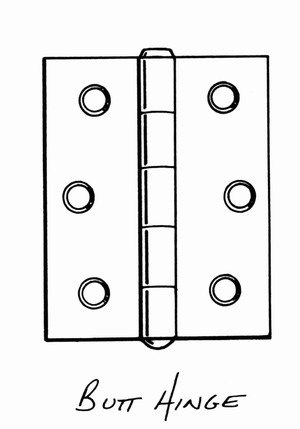
Description: This has two rectangular leaves with screw holes joined by a pin or rod.
Buying information: As mentioned above, if a hinge looks strong enough to support a door, it likely is. But as a rule of thumb, for a normal-weight interior sash door 1 3/8 inches thick or a hollow-core flush (flat and smooth) door, use a pair of 3 1/2-by-3 1/2-inch butt hinges; for a solid door 1 3/8 inches thick, use 1 1/2 pairs (3 hinges) of 3 1/2-by-3 1/2-inch hinges; for a door 1 3/4 inches thick, use 1 1/2 pairs of 4-by-4-inch hinges; and for louvered closet doors 1 1/8 inches thick, use one pair of 3-by-3-inch hinges.
Note that butt hinges can be obtained with "loose" or "fast" pins. Loose pins can be removed and the door taken down; fast pins cannot be removed and the door cannot be taken down, a security plus.
How-to hints: Butt hinges are mortised into the door and frame: one leaf goes into a recess in the frame and the other into the side of the door. To facilitate placement, there is a handy device called a butt marker, which comes in the shape of a standard butt hinge but has turned-over, sharpened edges. Place the butt marker on the door or frame, rap with a hammer, then clean out the scored area with a chisel and hammer.
Description of Contents
 IntroductionBracesCabinet Door PartsCastersChain And AccessoriesClampsCloset Door PartsDoor LocksDoorstopsDrapery PartsDrawer PartsFraming FastenersGarage Door PartsGutterHandlesHaspsHingesMetalsNailsNuts And BoltsPlant HangersRivetsRope, Cord And AccessoriesScreeningScrew Eyes And HooksScrewsShelf SupportsSpringsStorm & Screen Door PartsWall FastenersWeather StrippingWindow PartsWireWire FencingMiscellaneous
OTHER HARDWARE SECTIONS
ELECTRICALPLUMBINGADHESIVES, PATCHES & MORESAFETY